
Transfer money to and from China
Cross-border payments involving China are common in global trade, but transfers depend on correct contracts, bank registration, and supporting documentation.
This page covers personal limits, business payments for goods and services, and practical steps to reduce delays caused by paperwork issues.
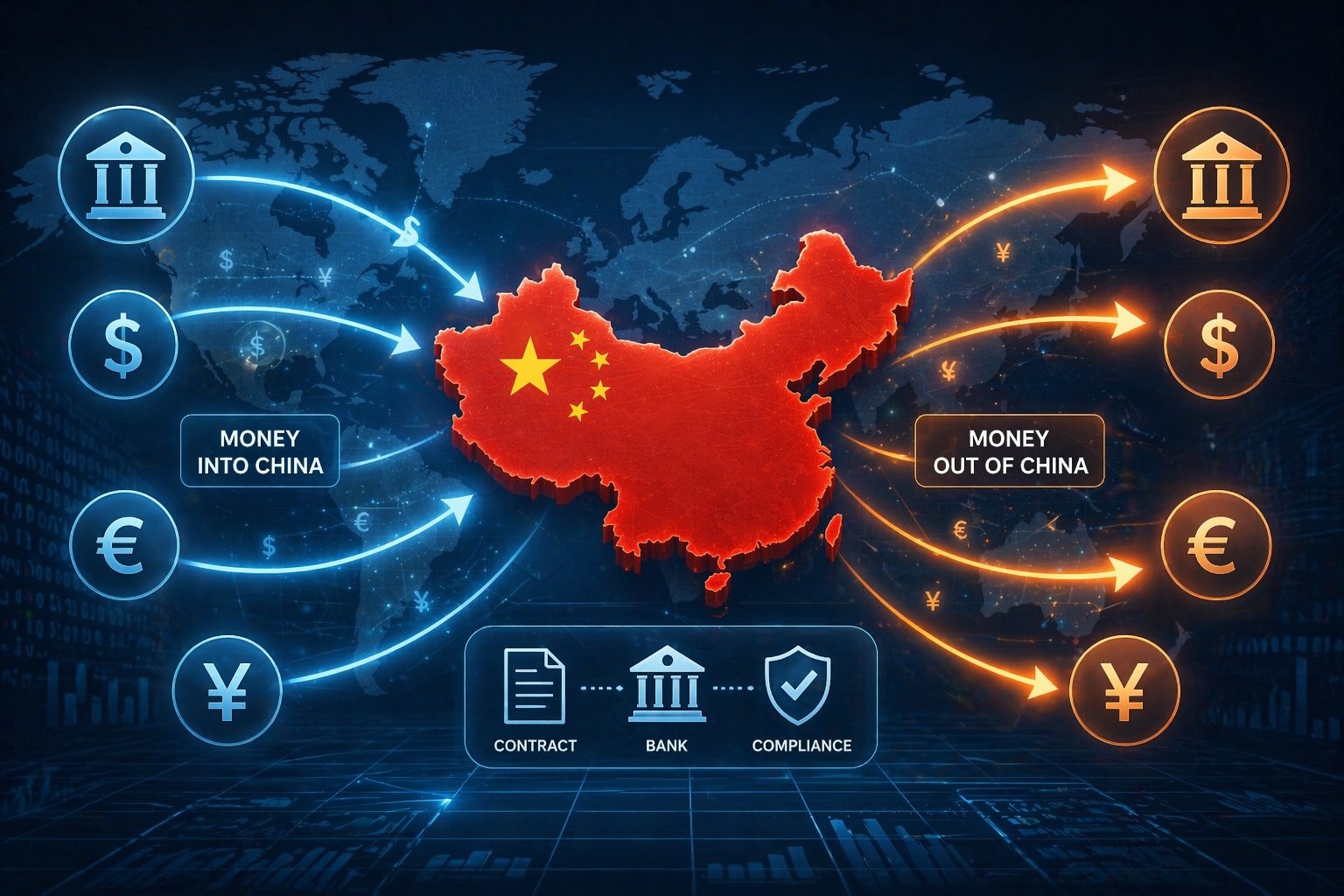
Can Chinese citizens transfer money overseas?
Chinese citizens are limited in how much money they can transfer overseas. As of January 2025, the limit was approximately $50,000 per year per person.
A Chinese person can hold cash or foreign currency in a bank account or on credit cards. This enables a Chinese citizen to make purchases abroad using a Chinese credit card, typically with a UnionPay card rather than a Mastercard or Visa card.
These credit cards also enable Chinese citizens to purchase goods from overseas websites, provided they can process UnionPay transactions.
This arrangement enables Chinese people to travel worldwide or send their children to overseas schools.
Chinese citizens must register any overseas interests, monies, property, etc. This is the same in most countries, where overseas interests must be declared for tax purposes, etc.
In general, it prevents large sums of money from being moved overseas from China without the agreement of local Chinese authorities.
Business transfers to and from China
Businesses can generally trade freely with Chinese companies. A central part of China's success story over the last 50 years has been its global trade. If the rules and regulations are followed, the transfer of money to and from China will be successful.
1) Purchasing goods from China
When purchasing goods from China, a Chinese export agent arranges and processes the agreement in China. Therefore, two businesses are often involved in a Chinese trade show stand: the supplier/manufacturer and the Chinese export agent.
Payment terms will always be in an overseas currency, commonly US$. If the payment is made in Chinese RMB, the Chinese export agent cannot claim a refund of the sales tax from the government.
The Chinese export agent will submit the paperwork to the authorities, including the sales agreement, to the bank. The bank will then be able to accept overseas payments and pass them on to Chinese businesses in Chinese RMB.
2) Purchasing goods from overseas countries
This is generally the same process as purchasing goods from China. The Chinese business making the purchase appoints a Chinese export agent.
The Chinese export agent will prepare the necessary import documents, including registering the purchase agreement with the Chinese bank. Once the bank has accepted the deal, overseas payments can be made, provided the contract terms have been met and supporting documentation is in place.
When trading goods to/from China, all countries involved have an audit trail of the transaction through customers; therefore, monitoring and controls are straightforward.
This becomes more complex when trading services, where no goods are physically moved.
3) Purchasing services from China
This is the most underdeveloped market at the moment. Most examples of services purchased from China will relate to travel or Chinese information technology services.
Most purchases from China are for goods; therefore, any service fees, such as export agent fees and shipping insurance, are included in the purchase cost.
The Chinese business will register the agreement with the Chinese bank if it purchases services from China. The Chinese bank / Chinese business can then receive the payment.
4) Purchasing services from overseas
The purchase of services from overseas between businesses is straightforward.
The service agreement is registered with the Chinese bank. If the Chinese bank accepts the agreement, payments can be made upon confirmation that the services have been provided and that the invoices have been submitted to the bank for payment.
If large sums of money are involved, we recommend seeking advice from a primary Chinese export agent and a local Chinese legal firm. Make a local legal appointment to protect your Chinese interests.
Again, purchasing overseas services by a Chinese citizen, e.g., school fees, is straightforward, provided the annual purchase value stays within the $40,000 pa limit. Using their credit card to complete the transaction is straightforward, provided the overseas business can accept UnionPay.
Transfers between related companies
You can transfer money in and out of China, provided the authorities and the bank create and agree upon the correct papers at the outset of your Chinese business.
When setting up an investment in a Chinese business, we recommend appointing someone you trust with strong local Chinese trading knowledge and experience. Keeping up with the rules and regulations takes time and money.
Most problems with transferring money between companies are caused by incorrect paperwork or misunderstandings of the rules and regulations.
Notes and common misunderstandings
Some overseas banks offer Chinese RMB accounts. While there may be a currency-conversion reason for doing this, it has limited commercial use, as you can only spend Chinese RMB in China, and Chinese export agents do not like trading in Chinese RMB.
The Chinese authorities fix the RMB exchange rate to the US dollar. This rate changes occasionally, usually only by a few per cent. Therefore, the money you receive in your local currency will depend on the Sus exchange rate.
Use these checks to reduce delays and failed transfers.
Quick checklist
Use these checks to keep trust and usability high.
- Is the contract clear and consistent with invoices and delivery/service evidence?
- Is the agreement registered with the relevant Chinese bank where required?
- For goods: is export/import agent paperwork complete and correct?
- For services: do you have acceptance evidence and compliant invoices?
- For personal payments: are you inside annual limits and using compliant channels (e.g., UnionPay where applicable)?
Need help?
If you’d like help improving mobile usability and China accessibility while keeping an authentic overseas brand feel, contact This email address is being protected from spambots. You need JavaScript enabled to view it.
Chinese Website Hosting service
- Very fast access to the internet in China (under 35ms)
- Very fast access to the Chinese DNS/NS network for Domain name lookup (under 75ms)
- No ICP license required