
Successful trading in China
A practical checklist for reducing risk and increasing success when trading with China.
Covers trademark protection, IP, China market research, government funding signals, and validating business contacts.
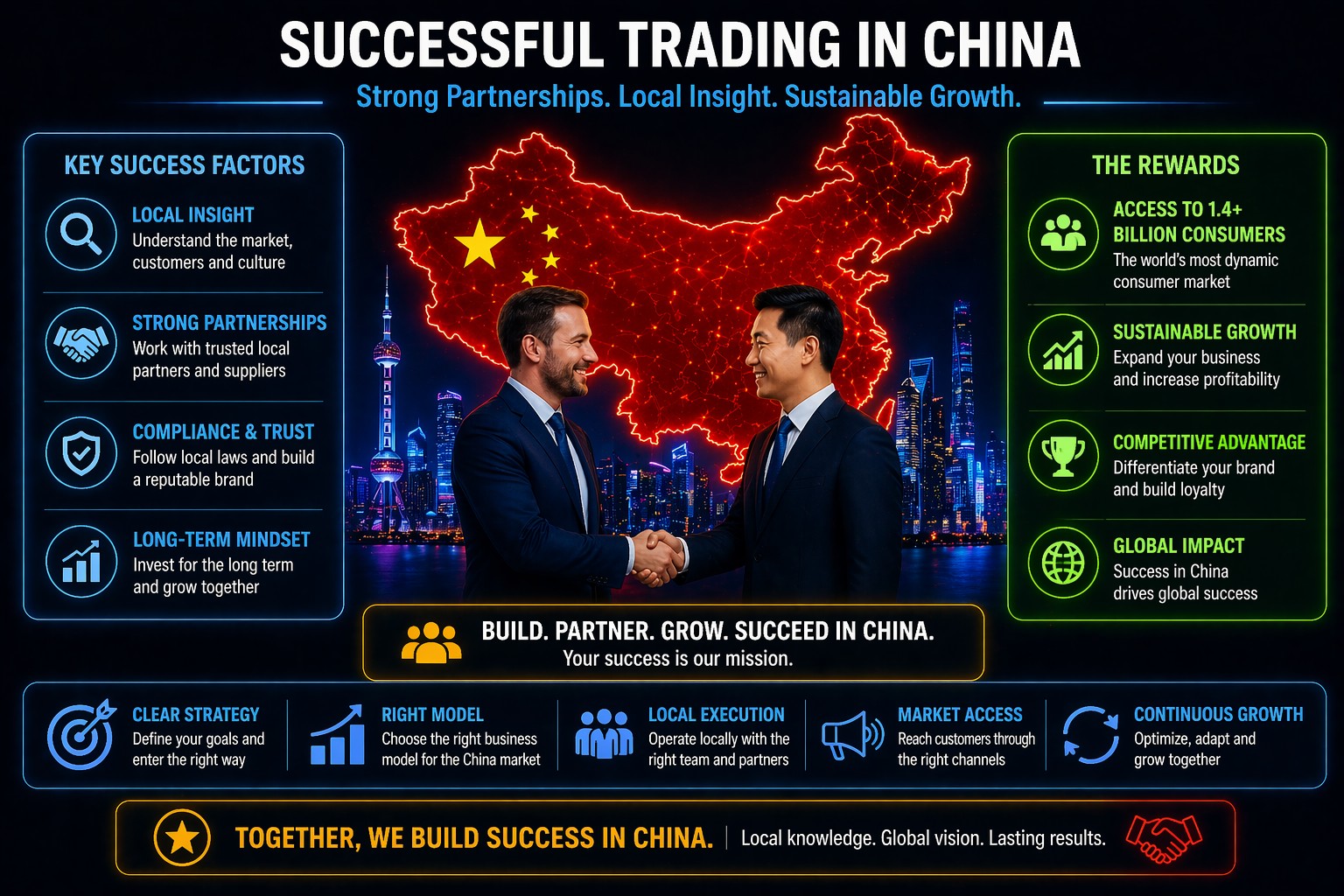
Experience matters
Access to China and its directors have been working and trading in China for over twenty years.
While Access to China primarily focuses on IT services, we also assist Chinese companies in sourcing products and services from overseas companies.
There are many books and websites dedicated to trading with China. Below are a few practical points for building a stronger foundation.
Brand ownership in China
Brand protection does not automatically carry between the UK / EU / USA and mainland China.
A brand can be registered in China by a Chinese or international company, which can remove your trading rights to use it in China.
We recommend registering your brands, trademarks, and logos in mainland China.
Intellectual property protection
As with branding ownership, it is essential to ensure your company’s intellectual property rights are protected.
A protected intellectual property position can provide additional benefits for new ideas and technical development, including access to regional funding support.
Research your products and brand inside China
Your research can start without travelling to China.
Look for your products and brands on Asian websites and search engines.
You may find the market has already formed — for example, overseas retail products can be resold into China.
Government funding and the Five‑Year Plan
Chinese development is guided by five‑year plans and significant investment in business and infrastructure.
Many large Chinese businesses are government-owned, and progress is measured against the five‑year plan.
Some SMEs receive funding if they demonstrate how they will contribute to plan goals.
JV requests and what they can signal
Some new companies ask for a JV with overseas companies to access funding or meet plan goals, such as moving manufacturing to China, gaining new technologies, or creating local employment.
Funding is not necessarily bad — but you need to understand the funding source before investing time and money.
Who are you talking to?
Chinese contact is one of the hardest issues in any country: who are you talking to, and what role do they really hold?
Use the internet to find as much information as possible about the business.
Sometimes you will see multiple business cards with different company names — check the relationships between companies.
Reading the room and keeping things simple
Identifying the power base in a meeting is difficult. Often, the person with nothing to prove asks the fewest questions.
Government staff can no longer receive expensive gifts or be taken for costly meals — keep things simple and to the point.
Always walk away if it does not feel right. If necessary, they will come and find you.
Get references and independent support
Seek assistance from international trading organisations, references, and other relevant sources.
See the useful links for additional information.
Use these checks as your minimum due diligence before committing time and money.
Quick checklist
Use these checks to keep trust and usability high.
- Have you registered your trademark/brand in mainland China?
- Have you protected key IP before sharing detailed information?
- Have you researched your product/brand on Chinese platforms and search engines?
- Have you checked whether the partner’s goals align with China’s current Five‑Year Plan themes?
- Do you know who holds decision power (and have you verified company relationships)?
- Have you obtained independent references and third‑party validation?
Need help?
If you’d like help improving mobile usability and China accessibility while keeping an authentic overseas brand feel, contact This email address is being protected from spambots. You need JavaScript enabled to view it.