
Routes to the Chinese markets
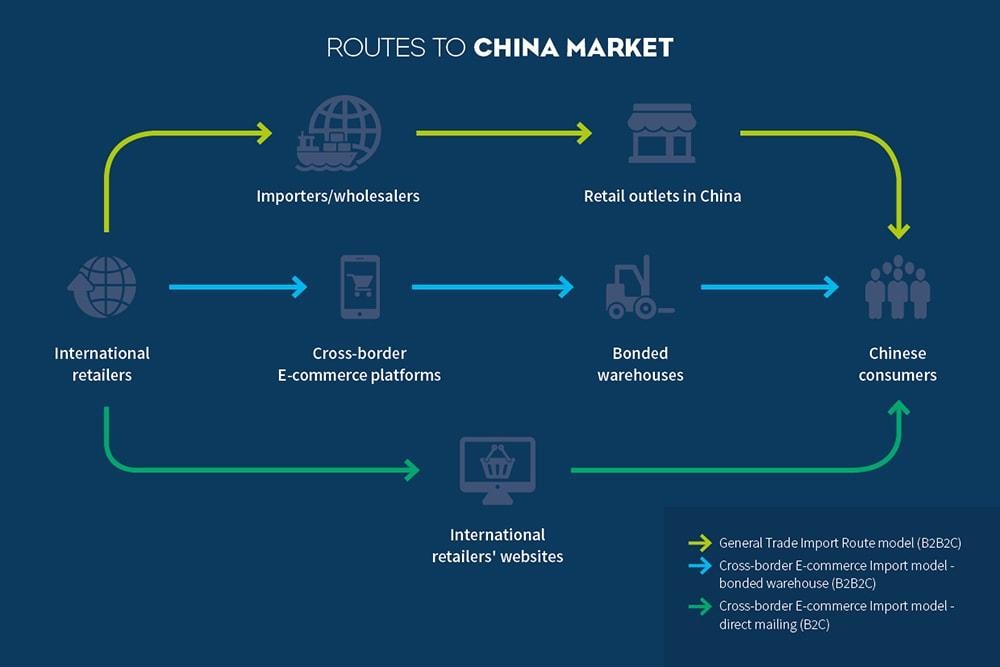
There are different trading routes for Chinese businesses (B2B) and Chinese consumers (B2C) — in China, in your local market, online, or in person with visitors from China.
Before you start, protect your brand in China and understand certification and channel options so you can expand without locking yourself into a single route.
Start with brand and compliance
Before trading, review your branding in China. If your business branding is not registered in China, correct this ASAP. Another company can undermine your marketing efforts by registering your brand(s) and reproducing products/services locally.
If you are selling goods inside China, products may require local certification (e.g., CCC). Importers usually manage certification, but it can be appropriate for your business to be involved so you own the final documentation.
Your local market: Chinese visitors and internet sales
Many Chinese citizens study and work abroad. Visitors can see products first-hand and share information on Chinese social media, which can increase interest.
Chinese buyers often prefer overseas suppliers for perceived quality and authentic branding. Develop relationships with Chinese social media users with large followings and provide links to online content.
Your local market: direct Chinese sales
Chinese visitors can be supported by:
- Local internet presence plus accessibility in China (with a short Chinese introduction)
- Meetings at trade shows
- Local trade organisations
This approach builds connections in China from within your local country and is often supported by trade organisations.
Direct selling to the Chinese market
Proactive marketing and sales strategies can begin without visiting China. The internet lets you do early-stage work from your office.
- Chinese B2B marketing (e.g., Alibaba)
- Chinese B2C distribution channels (e‑Malls)
- Chinese social media (e.g., WeChat)
- New overseas channels (e.g., b2b66 project)
Appoint a local Chinese agent
A Chinese agent can become your local representative in Chinese markets. Success is networking-based—learn as much as you can about their network.
- Do not appoint an agent for all of China or an entire region
- Use performance-based targets and a clear termination clause
- Ensure B2C selling via e‑Malls can continue where appropriate
- Allow Chinese customers to approach your business directly
- Register trademarks in your company name before deep engagement
Distributor, office, licensing, JV, and WFOE
- Distributor: handles importing, storage, shipping, returns, servicing, and payments—aim for payment before arrival.
- Representative office: local contact and language support without full entity setup.
- Licensing: can be cost-effective; ensure your company name is on certifications and documents.
- Joint Venture (JV): less common now, but may help access funding or special agreements.
- WFOE: easier than before, but costly—consider after trying other options.
Use these checks to keep routes realistic and protect your position early.
Quick checklist
Use these checks to keep trust and usability high.
- Are your trademarks registered in China in your company name?
- Do your products require China certification (CCC or similar) for in‑China sales?
- Which route fits your stage: local visitors, online B2B, B2C e‑Malls, agents, or distributors?
- If using an agent, is the agreement performance-based with a clear exit clause?
- Have you avoided exclusivity that blocks other channels and direct enquiries?
Need help?
If you’d like help improving mobile usability and China accessibility while keeping an authentic overseas brand feel, contact This email address is being protected from spambots. You need JavaScript enabled to view it.