
Business‑to‑consumer (B2C)
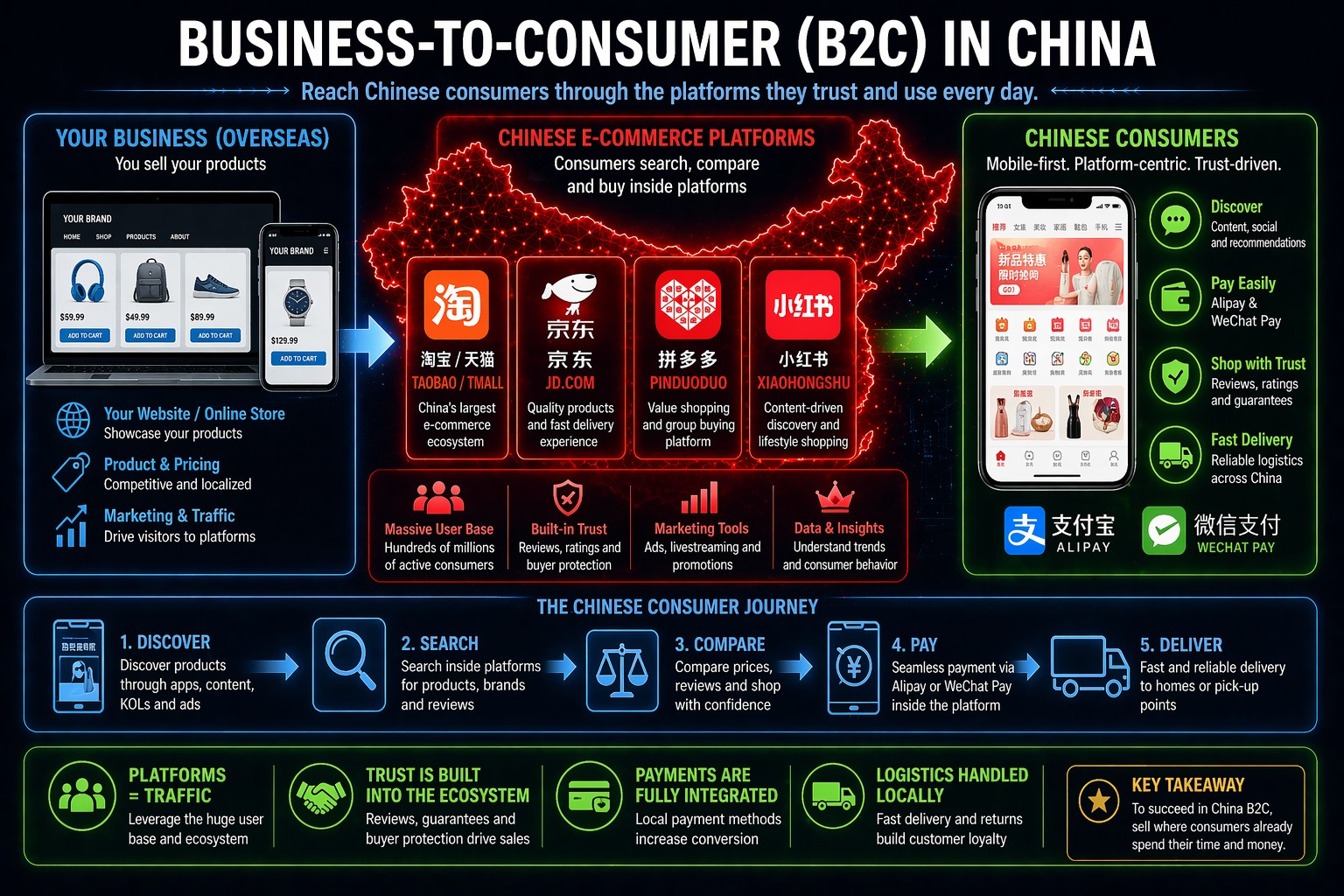
China’s B2C market is built around local e‑Malls that handle payments, logistics, and returns end‑to‑end.
This page explains how B2C developed in China, the rules that apply, and how overseas companies can enter safely.
How B2C developed in China
Chinese business-to-consumer (B2C)
The Internet has allowed the development of the Business-to-consumer market in China.
Historical: before the Internet
In the past, most consumer products were purchased at the local department store. The local stores selling consumer products had a limited selection and were not part of a chain.
Store chains exist in China but are limited to large cities and shopping malls. In the past, both Chinese and overseas chain stores have not always been welcomed by local retailers and consumers, as they can force local retailers out of the market. Local retail can put pressure on a chain store and move it to close!
Given the lack of purchasing power of chain stores and local competitors, most Chinese-made products outside China are cheaper.
The rise of Chinese e‑Malls
Overseas goods were sold in licensed overseas stores at considerably marked-up prices.
Historical: the development of B2C Internet trading
The consumer market underwent significant changes with the introduction of local e-Mall department stores.
Before China had access to local websites, the overseas e-Malls were always available. Some were accessible from China, not because they were blocked, but because they were too slow or inaccessible.
The other key issue was door-to-door delivery. International delivery was costly, and returning the goods was too expensive.
One of the first local e-malls was Amazon China, a joint venture between China Company and Amazon.
Taobao, created by Alibaba, followed this.
Taobao was a tremendous success;
Market penetration – Alibaba had access to most of the suppliers on the internet
They resolve the end-to-end processing issues;
Payment processing, Alipay
Delivery systems
Returns processing
Social Media - Weibo
Rules and regulations
They welcome Chinese-made products at low prices and are accessible to all.
Later, TMall (Alibaba) was added for “upmarket” products, and TMall Global for overseas companies
360Buy, now known as JDbuy, is the major competitor to Alibaba e-Malls.
JDbuy's advantage over Alibaba is its trading / commercial relationship with WeChat (Tencent). Given this relationship, we expect JDbuy's market share to grow significantly in the next few years (see BATs for more information).
Amazon China has a meagre percentage of the Chinese market. They lost their market share to Taobao, which created an end-to-end solution with greater marketing reach.
A summary of the Chinese rules and regulations
Selling online on a Chinese-hosted website requires certification, which is only available to a Chinese business
Any product sold on a Chinese internet site is subject to Chinese rules and regulations
Chinese e‑Mall market today
Products sold on websites outside China to a Chinese consumer are not subject to Chinese rules and regulations
Products imported to China are subject to duty and taxes
B2C purchased from foreign internet sites are not subject to Chinese product certification rules (i.e. overseas cosmetic products sold directly to a consumer do not require Chinese product certification)
Chinese e-Mall market today
Today's good news is that e-Mall department stores help suppliers trade end-to-end, including sales, payments, imports, shipping, taxes, and more.
These services cost more than trading on Amazon or eBay outside China.
Many Chinese businesses feel that trading in e-Malls is very expensive and that only e-Malls can make a high profit.
These e-Malls have many problems, as counterfeit products (or copy products, as they are called in China) are sold.
The biggest online trading day in China is 11 November, Bachelor's Day.
Chinese overseas B2C e-Mall companies
Overseas B2C opportunities
Many overseas businesses see their products sold at higher prices, believing there are high margins to be made in China. The prices often include;
International shipping costs
The local shipping costs
Custom fees
Import taxes
Sales taxes
i.e., what you often see on the internet in China is the net price for the end consumer.
There is a vast consumer market in China.
First, you must own your brand in China. If you own a brand registration in China, you can control who can sell your products online from a Chinese website, which is generally not available in the rest of the world!
After taking control of your company’s brand in China, you start working on reducing distribution costs, e.g., shipping in bulk, creating a Chinese company, and reducing transaction fees.
Transaction fees are often higher for overseas companies
E-Mall membership fees
Getting started safely
Deposits
Transaction fee
Payment fees
If you have the business case, make sure you have your overseas company name, brand ownership in China and Chinese product certification (as required)
The good news is that you can start your business case today without travelling to China. Search for Chinese e-Malls offering products similar to yours to determine if there is a market for your business in China.
Use these checks before starting B2C sales into China.
Quick checklist
Use these checks to keep trust and usability high.
- Do you own your brand registration in China?
- Have you confirmed whether products require certification if sold inside China?
- Have you compared overseas B2C versus Chinese e‑Mall costs?
- Have you checked transaction, membership, and payment fees?
- Have you tested demand on Chinese e‑Malls before committing resources?
Need help?
If you’d like help improving mobile usability and China accessibility while keeping an authentic overseas brand feel, contact This email address is being protected from spambots. You need JavaScript enabled to view it.