Improving Website Performance in China
This paper outlines cost-effective performance improvements that help your website or application perform better in China. Many of these recommendations also improve performance globally.
While China regulates internet content, e.g., by blocking international social media platforms, most issues with overseas websites stem from China's position on the global internet and its high-performance technical environment.
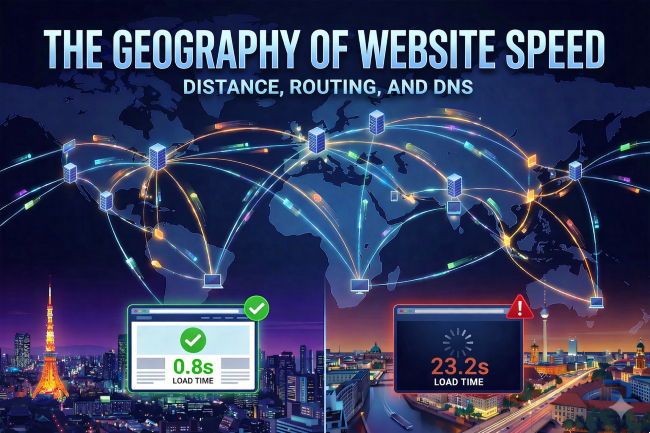
The global internet, for the most part, was built by U.S. providers. China was over 10 years behind the rest of the world in its internet rollout. This has led to significant performance issues with internet connections to and from China. In most cases, internet traffic from China is routed to North America regardless of the final destination; for example, traffic from China to Europe is routed through the USA, adding 10s of seconds to a website's performance.
Why Website Performance Matters in China
Only 25% of foreign websites are accessible in China; 20% take more than 20 seconds to load, and 55% are inaccessible.
The internet in China is one of the fastest in the world. It is built for over a billion daily users who demand and get fast performance. The internet in China has been and remains a major technical success story. Poor-performing overseas websites do not meet the needs of Chinese businesses or consumers.
The internet is a global infrastructure that costs hundreds of billions of dollars to build and operate, much of which is driven by energy consumption. Improving performance is therefore both an enhancement of the customer experience and a gain in resource and energy efficiency.
In this sense, performance optimisation is both a green initiative and a commercial one.
Overseas DNS Performance
DNS resolution for overseas-registered domains is slow and unreliable in China.
Your domain name's DNS record lookup is taking too long (over 250ms) for the Chinese internet (requiring a response time of 100ms) and results in your website being reported to the user as “not found.
To address this, use the China Name Server (DNS) service.
Internet performance
Global Routing Inefficiencies
Public internet traffic from China to the rest of the world is routed through Japan and Taiwan (not Hong Kong), then on to North America before reaching any overseas servers. This does significantly increase response times.
Hosting in Hong Kong is often seen as a quick way to access the Chinese internet. For U.S. internet providers, the route from Hong Kong to North America crosses the Pacific Ocean again, then enters China via Japan and Taiwan, making it one of the slowest internet connections in the world. This service is often unavailable in overseas data centres operating in Hong Kong. It requires an agreement with Chinese network carriers.
Limited International Bandwidth
The Pacific submarine cables have physical capacity limits for the traffic they can carry. Congestion is common, especially during business hours and peak usage periods.
To overcome this problem, host your website's large files and/or the website itself in Japan and Taiwan. Ensure the hosting provider has a direct connection to mainland China; not all do.
Avoid hosting services in Hong Kong unless your service provider has a direct internet connection to mainland China.
Content Restrictions
China's internet blocks or restricts access to many overseas platforms that lack agreements to adapt content for the Chinese market. These include:
- International social media
- International multimedia platforms, e.g. YouTube
- Third-party systems and services, e.g. Google, reCAPTCHA
- International hosting services, e.g. CDNs
This can cause missing website elements, slow page load times, or broken layouts.
Bing is an example of an overseas platform that works with the Chinese authorities to make its service available in China. While this agreement has been in place for many years, 2025 was the fastest growing search engine in China.
Multi-media contents
Image Size and Media Optimisation
Images on many websites are significantly larger than they appear. Oversized images increase download time, server load, and degrade performance in China.
For example, if the maximum banner image width is 1,800px, ensure the image is resized to 1,800px. It will not change your website's appearance, but it will load faster.
Overly large image sizes are prevalent in online content. It is simple to correct.
-
- Improve your internet performance
- Reduce user “bouncing”
- Reduce internet usage. If we all did this, the internet would run faster and require less power
Mobile and tablet considerations
Image optimisation is even more critical on mobile networks, which typically have lower bandwidth and higher latency.
Given CDN service issues in China, we recommend that you control image sizing on your website in HTML, e.g., by adding the “picture” tag.
Prioritised image loading (Lazy Loading)
Images should load from top to bottom, displaying the most important content first. This improves perceived performance and reduces unnecessary data transfer.
Third-Party Resources and Embedded Services
Modern websites often load content from many external sources. While convenient, this can severely impact performance in China.
Many of these services are blocked in China or slowed to the point of being unusable.
To overcome these problems, move/copy the content to your own website, removing the need for third-party resources.
Fonts and External Libraries
Services such as Google Fonts can take an extremely long time to load in China, sometimes blocking text rendering entirely.
CDN Dependencies
CDNs are effective for large global platforms but are often unnecessary and slow for typical business websites serving China.
Embedded Social Media
Overseas social platforms are blocked in China. Embedded social feeds often result in missing content or broken layouts.
ReCAPTCHA often does not work in China.
If you wish Chinese consumers to purchase your products and services in China without using a VPN, you will need to review the use of reCAPTCHA software and systems. A Chinese consumer could be trying to complete a purchase, only to be stopped by a non-working reCAPTCHA.
Some reCAPTCHA services do not work reliably when accessed from mainland China.
Google’s reCAPTCHA may fail to load because Google domains are frequently blocked or unreachable within the Chinese internet. When this happens, visitors may be unable to submit contact forms or complete registrations.
Google provides a workaround by allowing reCAPTCHA resources to be loaded from recaptcha.net instead of google.com. This domain is also operated by Google and often works when the main Google domain is blocked.
However, this approach still relies on external services. For websites targeting Chinese users, it is often more reliable to use local or self-hosted verification software. Running CAPTCHA or anti-spam protection on your own server removes the dependency on external domains and usually provides a more consistent experience for users accessing the site from China.
Block Chinese IP addresses through your web hosting service provider
Chinese authorities block overseas websites, but not very often; when they do, they block by IP address. Most websites share IP addresses, so your website may be blocked because of another website's content. If this happens, ask your hosting provider to change your website's IP address.
Malware and Bot traffic are prevalent worldwide. This is where people send many messages to your website.
Your website hosting provider blocked this traffic. In doing so, it also blocks traffic from Chinese social media. Chinese social media often includes links to overseas websites. This is generally good, as it indirectly promotes your company. This traffic is frequently mistaken for malware or bot traffic and is blocked. For example, WeChat opens a website inside its platform using the same source IP address, which can result in WeChat being blocked.
Upgrade HTTP/3 (QUIC) – Improving Performance on International Networks
Most websites run on HTTP/2. Adding HTTP/3 will improve your website performance in China and worldwide.
HTTP/3 is the latest version of the web protocol for delivering website content. Unlike previous versions, HTTP/3 uses a newer transport method (QUIC over UDP), designed to improve performance on high-latency and unstable networks.
For websites accessed from China, where international routing is complex and often congested, HTTP/3 can provide measurable benefits — but only in the right conditions.
Why HTTP/3 Matters for China-Facing Websites
International connections between China and overseas hosting environments often suffer from:
- High latency (long-distance routing via multiple countries)
- Packet loss (particularly on mobile networks)
- Congestion on international links
HTTP/3 is designed to improve performance in exactly these conditions:
- Faster connection setup (reduced handshake time)
- Better recovery from packet loss (no full connection stall)
- Improved performance on mobile and long-distance connections
In real-world scenarios, this can reduce delays in loading key website elements such as images, CSS, and JavaScript.
GDPR / PECR Consent Banners – Avoid Blocking Website Access
Many websites use GDPR or PECR consent systems that block access to content until the user accepts or rejects cookies. While this approach may meet compliance requirements, it can create significant accessibility and performance issues for international users.
In practice, these systems often rely on JavaScript and third-party services. For users accessing websites from China or other restricted or high-latency networks, this can result in:
- Consent banners failing to load correctly
- Pages appearing incomplete or unresponsive
- Users are unable to access content at all
This can lead to the perception that the website is unavailable, even when the core content is accessible.
Impact on SEO and AI Visibility
Blocking content behind consent mechanisms can also negatively affect how search engines and AI systems access and understand your website:
- Search engine crawlers may not execute consent scripts correctly, resulting in partial or empty page indexing
- Important content may be hidden behind overlays, reducing keyword visibility and page relevance
- Core Web Vitals may be negatively impacted due to delayed rendering and script execution
- Increased JavaScript dependency can reduce crawl efficiency and increase page load times
For AI systems and content indexing:
- AI crawlers may not interact with consent banners, leading to missing or incomplete data ingestion.
- Structured content and page context may not be fully visible, reducing the effectiveness of AI-driven summaries and search results.
- Websites may appear less authoritative if content cannot be consistently accessed and processed.
In both cases, blocking access can reduce discoverability, even if the content itself is high quality.
Practical Recommendation
- Avoid blocking access to content before consent is given
- Use a lightweight banner that allows the page to load normally
- Host consent scripts locally where possible
- Minimise reliance on third-party services
- Consider cookieless or server-based analytics to reduce compliance complexity
Quick checklist
Use these as a quick scan before running deeper tests.
- Are DNS lookups slow or unreliable from Chinese networks?
- Do pages rely on blocked resources (Google, global social platforms)?
- Are critical JS/CSS files hosted outside China and subject to poor routing?
- Is the website's appearance correct?
- Images are downloading slowly due to file size, international internet connectivity, or poor CDN performance in China?
- Is there any missing content, e.g., Social media?
- What is the time it takes to open your home page?
Need help?
If you need help reviewing and correcting your website visibility in China, please do not hesitate to get in contact. This email address is being protected from spambots. You need JavaScript enabled to view it.