Great Chinese firewall
China’s internet content rules are overseen by CNNIC and applied through ICP-style compliance for content published inside China.
In practice, most business sites aren’t “blocked”, but performance and third‑party dependencies (primarily Google and overseas social platforms) can make a website appear unavailable.
Who oversees internet content in China?
Chinese internet content is overseen by the China Internet Network Information Centre (CNNIC), which has published rules and regulations governing internet content in China.
CNNIC is also associated with ICP-style certification. Chinese businesses must obtain an ICP certificate before publishing online in China.
CNNIC oversees publications on the internet in China, including:
- Websites
- Social media
- Videos
- Apps
- …and other online services
These rules can apply to overseas internet content. However, they are not typically enforced for most overseas websites because many are difficult to access from within China.
The exception applies to overseas social media platforms, where there is no agreement with the overseas social media company to limit access to its content in China in line with published rules and regulations.
How China blocks or restricts content
China commonly uses two approaches to restrict content:
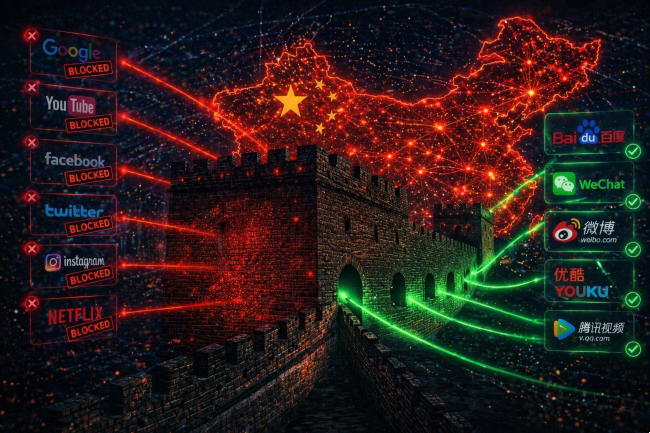
- Blocking by IP address: all content on a blocked IP address cannot be seen in China.
- Severe throttling of specific IP ranges: international traffic for certain IPs can be slowed so much that pages take 5–10 minutes to load (many Google IP ranges are affected). In our opinion, this is often the most effective method because it makes services unusable without clearly “blocking” them.
Respect local rules when doing business internationally
There are many views on whether this is good or bad. From a practical business perspective, we recommend respecting local rules and regulations when doing business internationally.
Many rules protect users and consumers from content that misleads, misinforms, or promotes harmful ideas. Although most business content is not directly affected, website content can still have a significant impact.
Content categories commonly restricted or difficult to access
- Political content: Some political topics are not allowed. Domestic news dominates Chinese social media; most international news is available but is not widely read.
- International social media: most global platforms are blocked. (LinkedIn previously operated in China but closed its China business a few years ago.)
- Pornographic content: not allowed.
- Google services: often not strictly “blocked”, but can be so slow that they are unusable.
Why this matters for overseas business websites
For overseas businesses, restrictions on overseas social media and Google can slow or prevent your internet content from being seen in China.
For overseas social media platforms, most are inaccessible in China. Availability can also change periodically.
Local “like” services: alternatives that work in China
When a service is unavailable in China, a local replacement is often available.
Video: YouTube vs YouKu
While YouTube is not available in China, many “like” services are available. The most prominent example is YouKu, which is broadly similar to YouTube (including ads).
In business, uploading videos to YouKu can provide fast local video playback. Embedding video into your own content typically requires more work but can yield better results.
This is an example of how a Chinese “like” product can outperform overseas products due to local performance and availability in mainland China.
File sharing: Dropbox vs Baidu Pan
Dropbox can be available in mainland China, but downloads are often slow. A common alternative is Baidu Pan (part of Baidu Cloud services).
While Baidu Pan may load more slowly from outside China, access speeds inside China can be fast.
Google dependencies: why pages “hang”
The statement “Google is blocked” is overly simplistic. Many Google services are reachable, but response times can be minutes long.
A typical example is Google Fonts. If your website loads fonts from Google-hosted servers, your content may not load within 5 minutes.
Quick checklist
Use this checklist when a page looks “blocked” in China.
- Is the site IP actually blocked, or is it just prolonged?
- Does the page depend on Google-hosted files (fonts, scripts, APIs)?
- Does the page embed overseas social media (widgets, scripts, videos)?
- Do third-party resources stall for minutes during load?
- Have you tested the full page load from within China (not just ping)?
- Can a China-local “like” service replace the blocked dependency (video, file share, etc.)?
Need help?
If you need help reviewing why your content is slow or unavailable in China, please get in contact. This email address is being protected from spambots. You need JavaScript enabled to view it.