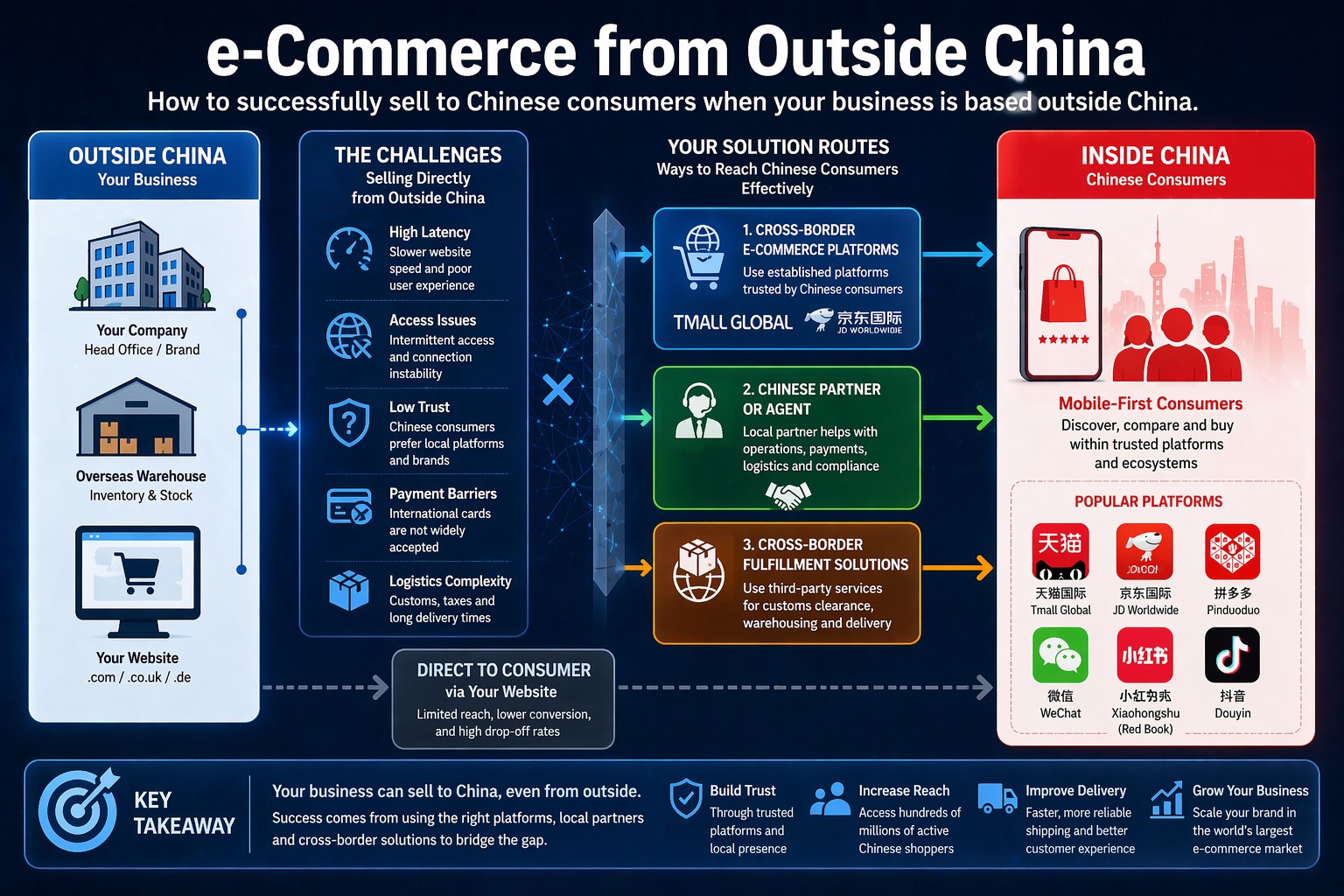
Select an article below. This index is designed to be fast to scan on mobile and easy to maintain as you upgrade pages.
Chinese internet structure
Maintaining an internet presence in mainland China is the most effective way to be visible on the Internet, provided your Chinese hosting provider has access to all three major networks: China Telecom, China Unicom (formerly China Netcom), and China Mobile. Your choice…
Chinese name servers (DNS records hosted in China)
International DNS (Domain Name Server) records can take two to three attempts for a browser in China to locate your website. After the first attempt, the user believes there is a typing error or that the website does not work. China's internet…
Domain names for the Chinese market
In 2022, Chinese authorities permitted overseas companies to purchase domain names from Chinese domain suppliers, such as Access to China, with domain ownership. This gives you full access to the Chinese Names Service across China. Purchasing a domain in China also gives…
Chinese top-level domains (TLDS)
The rules governing ownership of Chinese TLDs (.cn, .cn.com, etc.) do not allow overseas companies or individuals to own them. This may be unclear, as many internet companies sell Chinese domains to overseas companies or individuals worldwide. To achieve this, they use…
Great Chinese Firewall
The Chinese authorities exercise strict control over the content of the Internet, encompassing websites, social media, apps, and other online platforms within China. This pervasive control, often referred to by the overseas press and businesses as the Great Chinese Firewall, is a…
GEO DNS and CDN Services
Geo DNS, or Geographical Domain Name System, is a DNS-based service that routes users to different servers or IP addresses based on their geographical location. Many services are available worldwide, but most perform poorly in China. CDN stands for Content Delivery Network.…
The use of QR codes in China
Chinese social media platforms ingeniously tackled the language barrier by using them. When scanned, these codes provide access to services through embedded, long, and complex URLs. Consequently, QR code scanning has become ubiquitous among over one billion Chinese internet users. In China,…
Website looks and feels for the Chinese market
Chinese companies and consumers want to see overseas websites that resemble their local country's design and feel. They do not want to see a Chinese-looking site that raises questions about the product or service's genuine source. We recommend maintaining your local website's…
Translation of your business website
This unique circumstance stems from China's vast online population of approximately 854 million internet users, the largest in the world. The prevalence of advanced translation tools has enabled Chinese netizens to access and comprehend foreign content more efficiently. This approach not only…
Automatic translation
While translation tools are imperfect and may not always capture the nuances of your intended messaging, they provide a starting point for visitors who wish to explore your website in their native language. This approach can help mitigate some of the challenges…
Chinese Multimedia
Multimedia has become more important than written or spoken media. For example, good multimedia is the difference between success and failure in the hospitality industry. The same can be said for most products and services. Social media will create multimedia for your…
Chinese social media and e-commerce
Updating
Since approximately 2016, China has spearheaded the global landscape of social media and e-commerce development at an unprecedented pace. This rapid advancement has created a unique trend in China where social media and e-commerce have increasingly merged into a unified digital platform.…
Emailing in China
Like the rest of the world, it is not the primary tool for communication. WeChat has replaced most emails since its launch in January 2011. While most emails are encrypted during transmission, they are typically not stored as encrypted files on servers,…
Messaging in China
It has many of the same problems as email. We recommended opening a WeChat account for yourself or your business (a personal account is a more straightforward setup). Most Chinese enterprises and staff use WeChat as their primary communication tool. For example,…
Chinese telephones and mobiles
Most Chinese S&E business office desk phones are no longer used. Large companies still use desk telephone systems. Mobile calls are increasingly made over social media, such as WeChat. A good internet connection and local Wi-Fi support are essential for this. The…
APIS in China
Updating
Mobile apps are popular, so many mobile operating systems have reached the limit on the number of APIS allowed. The WeChat platform, launched in January 2011, addressed this issue by enabling you to run APIs within it. Today, APIS in China are…
Up-to-date internet content
Keeping your business content up-to-date with your products, services and business information is obvious. Many companies are increasingly finding this challenging, given the number of platforms and channels that must be updated with company information and data. When considering a new market…
Performance upgrades
Unless specifically developed, most websites utilise third-party services that are unavailable in China. Many websites include articles and images from social media. However, most social media sites outside China are blocked, leading to missing website information. Platform and cloud services, such as…